How WhatsApp template category changes your bill (and why to keep monitoring it)
Sundaram Singh
Co-Founder & Engineer
Last verified: October 2026. Meta updates its rate card regularly, so check current rates before budgeting.
Key takeaways
- •Since July 2025, Meta bills per delivered template message, not per 24-hour conversation.
- •The category is set by the template, and it changes the price per message.
- •Utility messages sent inside an open customer service window are free of Meta’s charge.
- •Add 18% GST, and your BSP’s fees on top.
- •Meta can reclassify a template after approval, so monitor status.
WhatsApp charges for template messages by category, and the gap between categories is large. Using approximate early-2026 India rates, a Marketing message costs several times what a Utility message costs, so a template in the wrong category can multiply your bill for the same send volume.
What changed in 2025
Meta moved from per-conversation to per-message pricing on July 1, 2025. Many guides online still describe the old conversation model, so check the date on anything you read. Rates also move: one source says Meta updates the rate card roughly every six months, and an India pricing breakdown notes a marketing rate increase in January 2026. Source: authgear.
The three categories and rough India rates
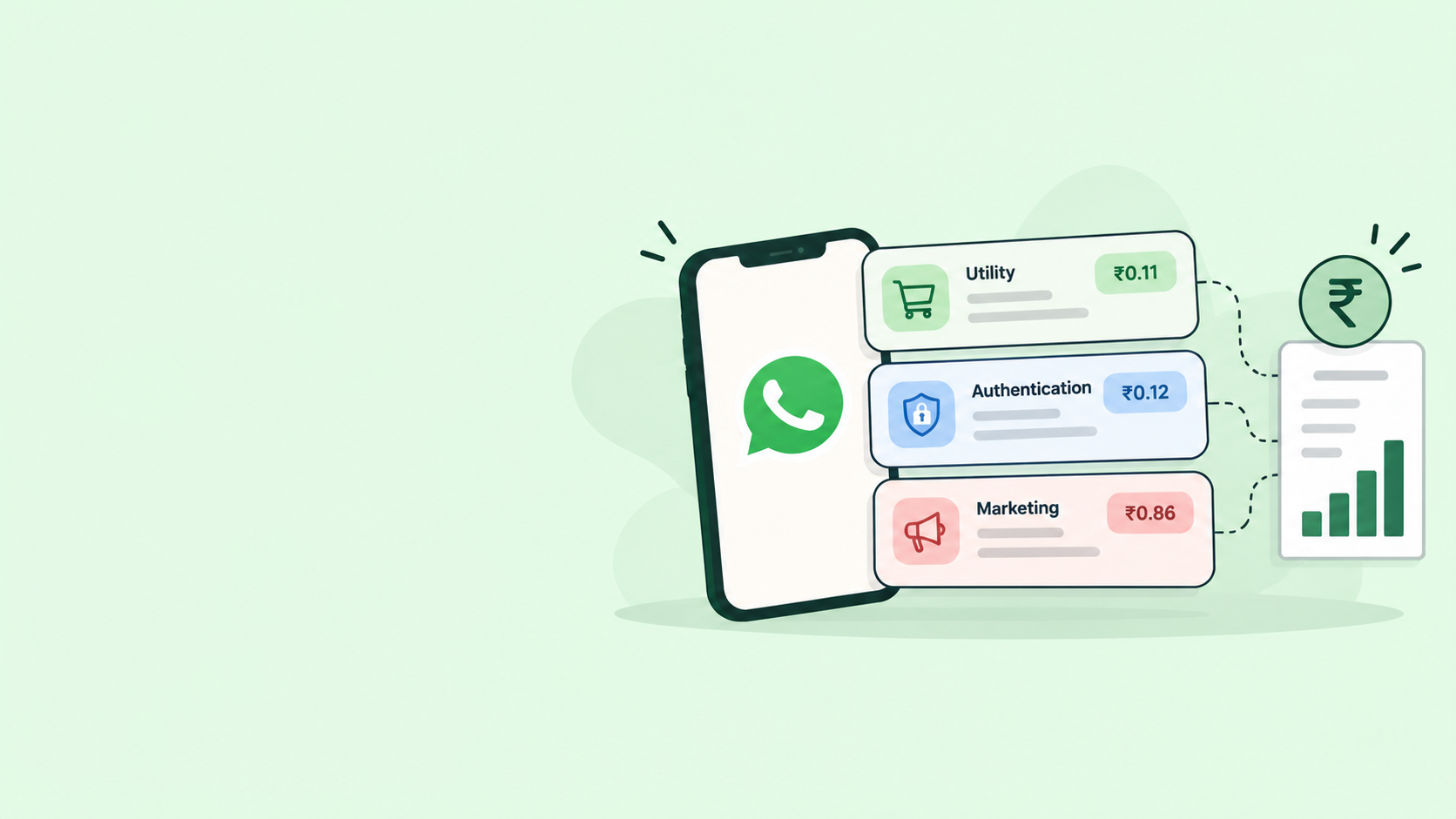
One breakdown of early-2026 India rates gives these approximate ranges per message:
- Marketing: roughly ₹0.78 to ₹0.88 (robylon).
- Utility: roughly ₹0.11 to ₹0.16, and ₹0 inside an open service window (robylon).
- Authentication: roughly ₹0.11 to ₹0.13 (robylon).
What the category means
Utility: transactional messages tied to something the customer did, such as an order update, a payment confirmation or an invoice for a purchase.
Authentication: one-time passwords and login codes.
Marketing: promotions, offers and announcements.
The category belongs to the template, not to how you feel about the message. One guide notes that a marketing template always triggers marketing rates, even if the content seems transactional. Another says the category is determined by the template you use, not each message’s content. Sources: campaignhq, dev.to.
An illustrative example
Say you send 5,000 order-update messages a month. Using approximate rates of ₹0.115 for Utility and ₹0.86 for Marketing, the monthly difference is roughly ₹3,700 before tax. One guide says correct classification can reduce the cost by 5 to 7 times. The ratio here is about 7.5 times. These are illustrative calculations using approximate rates, not Meta’s billing.
Then add tax and fees. The same breakdown says 18% GST applies to both Meta’s charges and your BSP’s platform fees. Remember BSP markups can nearly double the per-message cost, so compare providers on the total. Sources: montymobile, authgear.
Don’t game the category
It’s tempting to label promotions as Utility to save money. Don’t. Meta reviews templates, and one guide warns that promotional language in Utility templates gets rejected aggressively. Mislabeling can lead to rejection, reclassification or quality problems for your number. Write transactional templates that really are transactional, keep promotions in Marketing, and the savings follow honestly. Source: enablex.
Why monitoring matters
One India pricing guide warns that Meta may reclassify a template’s category after approval, changing the billing rate, and advises checking template status in WABA Manager after approval, not just at submission. If a Utility template quietly becomes Marketing, your costs rise without any change on your side. Source: montymobile.
A simple monitoring routine
- •Export your template list and categories monthly.
- •Compare category and status against last month.
- •Track cost per message by template in your own logs.
- •Set an alert when average cost per message jumps.
- •Re-check Meta’s rate card each quarter.
| Category | Approximate Rate | Monthly Meta Cost (5,000 sends, before GST) |
|---|---|---|
| Utility | ~₹0.115 | ~₹575 |
| Marketing | ~₹0.860 | ~₹4,300 |
Illustrative cost comparison for 5,000 order-update messages based on early-2026 benchmark rates (source: dev.to/chatlivo).
Frequently asked questions
Are service-window replies free?
Utility template messages sent inside an open customer service window are free of Meta’s charge, per the India breakdown above. Confirm current rules on Meta’s pricing page.
Do I pay for template approval?
One pricing guide lists template approval fees as zero, but your BSP may charge for template management.